Selecting your first yoga teacher training program feels overwhelming when multiple hour tiers compete for your attention. Choosing the wrong tier wastes both weeks of personal leave and thousands of dollars in travel expenses.
This comparative analysis clarifies the exact curriculum, daily practice demands, certification legitimacy, and career paths for 100-hour, 200-hour, and 300-hour courses. At AATM Yogashala in Rishikesh, we guide hundreds of international applicants annually through this precise decision matrix.
Quick Overview: Key Takeaways
- 100-Hour TTC: Introductory foundation for personal development; does not grant independent teaching credentials under Yoga Alliance guidelines.
- 200-Hour TTC: The foundational, globally mandatory benchmark for becoming a certified teacher (RYT 200). Best choice for most applicants.
- 300-Hour TTC: Advanced master-level training; strictly requires prior completion of an accredited 200-hour program to qualify for RYT 500 status.
What Do the “Hours” in Yoga Teacher Training Actually Mean?
Course hours denote structured contact instruction hours rather than casual self-study time spent reading manuals. Educational standards established by Yoga Alliance govern these specific curriculum blocks across registered schools globally.
Each hour represents supervised studio practice, anatomical analysis, pedagogical workshops, or philosophy lectures led by certified instructors. A legitimate 200-hour training compresses two hundred audited educational hours into twenty-four to twenty-eight calendar days.
Schools divide these hours across five core educational categories mandated by international credentialing boards:
- Techniques, Training, and Practice: Asana alignment, pranayama techniques, and kriya cleansing.
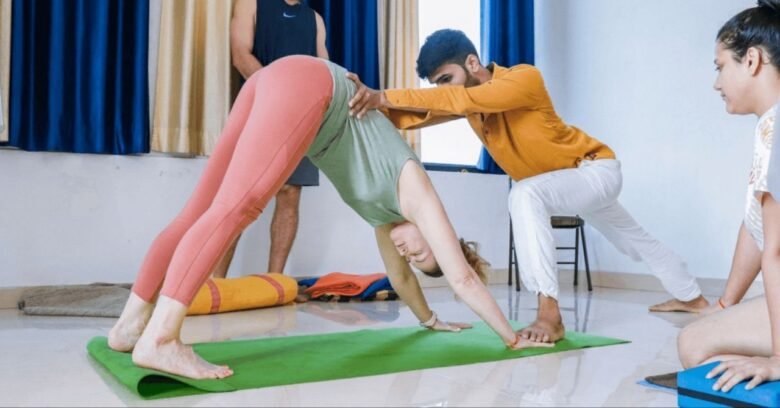
- Teaching Methodology: Hands-on adjustments, sequencing strategy, and group class management.
- Anatomy and Physiology: Biomechanics, joint mobility mechanics, and nervous system regulation.
- Yoga Philosophy, Lifestyle, and Ethics: Study of Patanjali’s Yoga Sutras and traditional lifestyle precepts.
- Practicum: Observed student teaching with constructive critique from senior mentors.
The 100-Hour Yoga Teacher Training Course: Purpose and Limitations
A 100-hour yoga teacher training in Rishikesh functions as an immersion primer spanning approximately eleven to fourteen days. It targets students lacking the four uninterrupted weeks necessary to complete a full certification in one trip.
This condensed format introduces primary Hatha and Ashtanga Vinyasa postures while grounding attendees in daily pranayama routines. Students sleep in the ashram environment, eat sattvic meals, and experience authentic monastic discipline without the pressure of final teaching examinations.
However, a standalone 100-hour course carries a decisive operational limitation: it yields no international license to lead commercial studio classes.
Students who finish a 100-hour module receive a certificate of completion representing half of an accredited foundational curriculum. They must return to complete a secondary 100-hour semester within an approved timeframe to earn their complete credentials.
Who Should Choose a 100-Hour Course?
- Dedicated practitioners seeking personal rejuvenation without professional teaching goals.
- Busy professionals with restricted annual leave allowances under two weeks.
- Beginners testing ashram life and physical endurance before committing substantial funds to full programs.
The 200-Hour Yoga Teacher Training Course: The Global Standard
The 200-hour yoga teacher training course represents the universal baseline for yoga instruction worldwide. Gymnasiums, specialized studios, retreat centers, and personal insurance carriers mandate this exact certification before contracting instructors.
Spanning twenty-four to twenty-eight days in Rishikesh, this rigorous syllabus develops beginner and intermediate practitioners into confident group leaders. Students deconstruct over eighty classical asanas, analyzing primary muscle engagement, skeletal contraindications, and manual adjustment techniques.
Rigorous research indexed by the National Institutes of Health confirms that structured yoga protocols deliver measurable autonomic and postural improvements when instructed by adequately trained leaders. This scientific responsibility makes extensive anatomical training mandatory within legitimate 200-hour courses.
Graduates qualify for the Registered Yoga Teacher (RYT 200) designation upon registration with international bodies. This credential proves your competency to design balanced class sequences, provide safe physical modifications, and preserve student safety.
200-Hour YTT Curriculum Breakdown:
- Asana Practice & Alignment: 100 Hours
- Philosophy & Yogic Ethics: 30 Hours
- Teaching Methodology & Practicum: 25 Hours
- Pranayama, Mudra & Meditation: 25 Hours
- Anatomy & Biomechanics: 20 Hours
Who Should Choose a 200-Hour Course?
- Anyone aspiring to teach yoga professionally in commercial studios, private clinics, or wellness retreats.
- Serious practitioners seeking an authentic, life-altering immersion in the birthplace of yoga.
- Instructors desiring solid grounding in foundational sequencing, anatomy, and Patanjali’s philosophical framework.
The 300-Hour Yoga Teacher Training Course: Advanced Mastery
A 300-hour yoga teacher training in Rishikesh represents second-tier postgraduate education designed exclusively for instructors holding an existing 200-hour certification. You cannot bypass the 200-hour level to enter a 300-hour course directly.
This advanced program explores complex multi-plane sequencing, therapeutic postural modifications, subtle energetic anatomy, and advanced pranayama. Instructors spend thirty days sharpening voice projection, breaking movement plateaus, and addressing chronic structural imbalances in student populations.
Upon graduating from an accredited 300-hour curriculum, instructors unite their 200-hour baseline with their new 300-hour credential to claim the RYT 500 qualification. This tier commands superior remuneration rates and qualifies teachers to lead international workshops, teacher training modules, and corporate retreats.
For dedicated professionals wanting uninterrupted development, enrolling in an integrated 500-hour yoga teacher training course completes both tiers across a continuous two-month residency.
Who Should Choose a 300-Hour Course?
- Working teachers with active studio experience seeking technical specialization.
- Instructors needing therapeutic modification knowledge to work with injured or elderly clients.
- Career yoga professionals targeting senior workshop leadership and school ownership.
Detailed Comparison: 100-Hour vs 200-Hour vs 300-Hour TTC
Review this side-by-side technical comparison before making your financial deposit:
| Evaluation Factor | 100-Hour Course | 200-Hour Course | 300-Hour Course |
|---|---|---|---|
| Primary Goal | Personal immersion & technique primer | Professional certification & foundation | Advanced mastery & specialization |
| Typical Duration | 11 to 14 Days | 24 to 28 Days | 28 to 30 Days |
| Prerequisites | None; beginners accepted | Basic yoga practice for 3 – 6 months | Prior accredited 200-hour certification |
| Teaching Credential | Non-teaching certificate of completion | Globally recognized RYT 200 license | Advanced RYT 500 credential (with 200hr) |
| Curriculum Depth | Fundamental postures & basic breathing | Comprehensive anatomy, sequencing, philosophy | Advanced therapeutics, subtle body, philosophy |
| Practicum Teaching | Minimal peer observation | 15 – 20 hours of hands-on student teaching | In-depth peer critiques & advanced adjustments |
| Average Cost in Rishikesh | $450 – $750 (Meals + private room included) | $900 – $1,500 (Meals + private room included) | $1,200 – $1,800 (Meals + private room included) |
| Career Outcome | Self-practice enrichment | Studio teacher, corporate coach, private tutor | Lead trainer, workshop leader, retreat host |
Syllabus Differences: What You Study in Each Tier
The pedagogical transition between these tiers determines your daily physical demand and mental focus inside the shala.
Course Complexity Progression:
- 100-Hour Tier: Surface Practice & Personal Immersion
- 200-Hour Tier: Structural Alignment & Primary Teaching Certification
- 300-Hour Tier: Advanced Therapeutics & Master-Level Sequencing
1. Asana Mechanics and Depth
In a 100-hour curriculum, students memorize structural shapes for classical postures. The focus centers on personal execution and discovering basic stability.
A 200-hour training pivots toward pedagogical mechanics. You dissect joint angles, bone-on-bone compression limits, and hands-on adjustments across forward folds, backbends, and inversions.
In a 300-hour course, instructors explore advanced arm balances, hip openers, and restorative biomechanics. You evaluate how spinal variations demand customized postural alternatives for private clients.
2. Anatomy and Biomechanics
- 100 Hours: Identification of primary muscular groups and basic diaphragmatic mechanics.
- 200 Hours: Skeletal architecture, muscular origins, muscle insertions, fascial networks, and joint safety protocols.
- 300 Hours: Pathological contraindications, biomechanics of trauma, nervous system down-regulation, and specialized rehabilitation techniques.
3. Philosophy and Ethics
- 100 Hours: General history of yoga and foundational introductions to the Yamas and Niyamas.
- 200 Hours: Rigorous analysis of Patanjali’s Yoga Sutras, Bhagavad Gita discourses, and ethical teacher-student boundaries.
- 300 Hours: Tantric scriptures, Samkhya dualism, comparative ancient philosophies, and modern business ethics for wellness entrepreneurs.
Daily Schedule: What a Day Looks Like in Rishikesh
Residential teacher training demands disciplined time management from sunrise to dusk. Regardless of course tier, our ashram schedule at AATM Yogashala builds focus through structured routine.
- 05:30 AM – 06:00 AM: Morning herbal tea and nasal cleansing (Shatkarma kriyas).
- 06:00 AM – 07:30 AM: Pranayama techniques, bandha locks, and silent morning meditation.
- 07:45 AM – 09:15 AM: Dynamic classical Hatha or Ashtanga Vinyasa asana class.
- 09:30 AM – 10:30 AM: Nutritious yogic breakfast prepared with fresh local ingredients.
- 10:45 AM – 12:00 PM: Functional yoga anatomy, joint mechanics, and posture adjustments.
- 12:15 PM – 01:15 PM: Yoga philosophy lecture and scriptural dialogue.
- 01:30 PM – 02:30 PM: Sattvic vegetarian lunch and restorative leisure period.
- 03:30 PM – 04:30 PM: Teaching methodology, sequencing drills, and alignment clinics.
- 04:45 PM – 06:15 PM: Evening Vinyasa flow, restorative yin, or sound healing session.
- 06:30 PM – 07:30 PM: Guided meditation, yoga nidra, or evening kirtan mantra chanting.
- 07:45 PM – 08:30 PM: Traditional community dinner.
- 09:30 PM: Lights out and mandatory silence (Mouna) until sunrise.
Financial Investment and Hidden Costs to Anticipate
The overall price of yoga training in India offers exceptional value compared to Western studio tuition fees. While courses in the United States or Western Europe frequently cost upwards of $3,500 for tuition alone, Rishikesh programs cover lodging and dining within their sticker rates.
Average Course Fees in Rishikesh (Residential)
- 100-Hour TTC: $450 – $750 (All-inclusive with accommodation and three daily meals).
- 200-Hour TTC: $950 – $1,450 (All-inclusive with private or shared room options).
- 300-Hour TTC: $1,250 – $1,850 (All-inclusive with study manuals and excursion trips).
Ancillary Travel Expenses to Budget
- Indian Visa: Approximate fee of $25 to $40 for tourist or e-visas depending on citizenship.
- Dehradun Airport Transfers: $20 to $30 private taxi transfer from Jolly Grant Airport (DED) to Tapovan.
- Yoga Alliance Registration: An initial $115 application and verification fee paid directly to the registry website upon graduation.
- Weekend Leisure and Excursions: $100 to $150 total for local temple visits, sound bowl purchases, and riverside dining.
Step-by-Step Decision Framework: Which Course Should You Choose?
Follow this systematic framework to confirm your enrollment tier:
- Calculate Available Travel Days: If your employer limits you to fourteen days, select the 100-hour module. If you can dedicate four weeks, select the 200-hour course immediately.
- Define Career Intentions: If your ambition includes charging fees for studio classes, leading online cohorts, or opening retreat operations, a 200-hour course is non-negotiable.
- Verify Prior Educational History: If you have already earned an accredited 200-hour certificate and completed active teaching, step up into the 300-hour curriculum.
- Clarify Learning Objectives: If your focus centers strictly on self-care, holistic healing, or stress relief, a therapeutic yoga and meditation retreat provides relaxation without examinations.
Frequently Asked Questions (FAQ)
1. Can I teach yoga professionally with a 100-hour certification?
A 100-hour certificate confirms your participation in an introductory course, but commercial studios require an accredited 200-hour credential for employment. Insurance providers generally deny liability policies to instructors lacking a minimum 200-hour certificate. You must complete the remaining 100 hours of study to qualify for formal teaching positions worldwide.
2. Is a 200-hour yoga teacher training enough to start a teaching career?
A 200-hour certification provides the legal baseline and practical competence necessary to instruct beginner and intermediate group classes. You gain hands-on training in class sequencing, postural safety modifications, cueing mechanics, and injury management. Most working yoga teachers lead classes for years under their 200-hour foundation before pursuing advanced study.
3. Can I skip the 200-hour course and take a 300-hour training directly?
You cannot enroll in an accredited 300-hour course without first completing a certified 200-hour yoga teacher training. The 300-hour curriculum builds directly upon foundational alignment rules and pedagogical assumptions taught during 200-hour programs. Skipping straight to advanced training is prohibited under international Yoga Alliance registration policies.
4. What is the difference between RYT 200 and RYT 500?
RYT 200 denotes an instructor who has passed an initial 200-hour course through a registered school. RYT 500 indicates a master teacher who finished both a 200-hour baseline and an advanced 300-hour post-graduate training. RYT 500 instructors command higher pay rates and qualify to direct their own certified teacher training programs.
5. What happens if I fail the practical examination during a 200-hour TTC?
Reputable schools prioritize continuous feedback so students identify and correct errors long before the final examination. If a student struggles during practical teaching assessments, instructors assign extra clinic hours and adjustment practice to build competence. You receive constructive mentoring until your class management and alignment cueing satisfy safety standards.
6. Are food and accommodation included in Rishikesh course fees?
Most accredited schools in Rishikesh include clean lodging and three daily vegetarian sattvic meals inside their published tuition fees. Students choose between private or shared accommodations with attached bathrooms and high-speed wireless internet. Choosing a residential all-inclusive package avoids daily meal hunting and preserves mental focus during training.
7. Do I need advanced flexibility to attend a 200-hour yoga teacher training?
You do not need to perform complex contortions or extreme arm balances to enroll in a 200-hour course. The curriculum focuses on postural alignment principles, joint safety, muscular action, and developing patience with physical limitations. Consistent dedication and an open mindset matter substantially more than natural skeletal flexibility.
8. How long is a yoga certification valid after graduating?
Your graduation diploma from an accredited yoga school remains valid for your lifetime without recurring institutional expiration dates. If you register your credentials with Yoga Alliance, you pay a small annual renewal fee to maintain active listing status. Continuing education credits every three years ensure your instructional techniques stay aligned with evolving biomechanical standards.
9. What styles of yoga are taught during a 200-hour training at AATM Yogashala?
Our 200-hour program focuses on traditional multi-style training, integrating classical Hatha Yoga alignment with dynamic Ashtanga Vinyasa flow sequences. Students master stationary alignment fundamentals before progressing into breath-linked movement transitions and adjustments. We also introduce restorative practices, Kundalini kriya techniques, and daily meditation routines.
10. How far in advance should I reserve my seat for teacher training in Rishikesh?
Students should submit their applications two to four months ahead to secure lodging preferences and confirm international travel arrangements. Class sizes at AATM Yogashala remain capped at twelve to fifteen students to guarantee personal mentoring from senior gurus. Early registration ensures sufficient time to obtain flight itineraries and complete online visa approvals.
Start Your Yoga Journey at AATM Yogashala
Selecting your yoga training program marks a significant crossroad in your personal wellness and professional career. Whether you begin with a foundational 200-hour certification, complete a 100-hour exploratory module, or elevate your teaching mastery through our advanced 300-hour course, authentic guidance remains the determining factor.
At AATM Yogashala, our internationally accredited faculty preserves traditional Vedic teachings within an encouraging ashram atmosphere located on the holy banks of the Ganges.
Ready to take the next step toward your official yoga teaching certification?
Submit Your Course Reservation Form Today to secure your seat for upcoming seasonal batches, or Contact Our Admissions Team for custom syllabus guidance and room arrangements.