
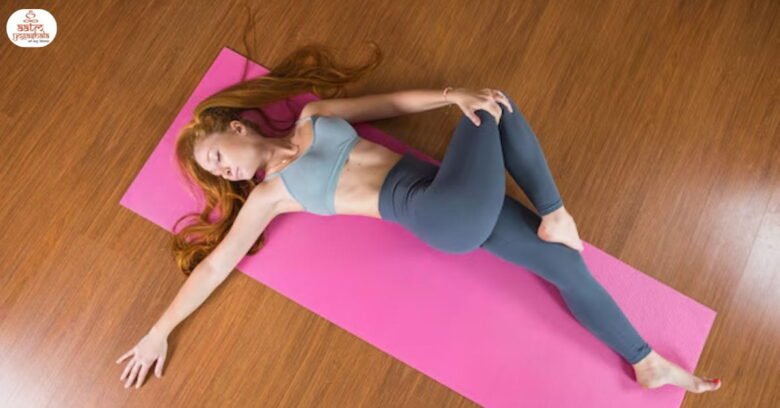
(Soop-tah-MOTS-yen-drAA-SUN-aa) – is a therapeutic spinal rotation, which extends and cleanses the spine, besides clearing out the internal organs. Supta Matsyendrasana is an easy technique that helps to stretch the spine, the shoulders, the back, the thighs, the neck and induce the internal detoxification system, when one is relaxing.
Supine twist stretch helps relax the lower back and release spinal tension. Polycystic ovary syndrome can be cured by regularly practising Supta Natarajasana, which is a Sanskrit-based word translated as Supta, indicating supine or reclined, Matsya, indicating fish, Indra, indicating ruler, and asana, indicating a posture.
How to do the Supine Twist Pose Yoga?
To perform supine poses in yoga for relaxation as well as for gentle stretching, lie back on the floor. Bend your right knee forward toward the ceiling and plant the sole of your right foot flat on the floor with your bent knee bent back over the top of your body.
- The foot should be pressed to raise the hip a little above the floor and move it 1 inch to the right.
- You can then lengthen your left leg on the mat flat when you exhale, and do not flex your left foot. Pull the right thigh in the direction of the chest.
- Breathe in and exhale once more, crossing the right knee over the centre of the body to the left side of the body. Lying twist improves spinal mobility and reduces stiffness.
- Now, will you have up a hip right above the left hip. It is also possible to tie the right foot behind the left knee.
- The arms should be closed on either side, creating a T shape of the Body. Place your right hand on your right knee.
- The head should be turned toward the right to see the right fingertips.
- You can maintain the posture for 5 to 7 deep breaths; it will be enough.
How to Get Out of the Supine Pose Yoga?
- Breathing in, slowly roll into a back-bend, right knee towards your chest. The supine twist pose in yoga supports better digestion and back flexibility.
- Extend your legs to the floor so that you neutralize your spine. Take a few deep breaths here before doing the same on the other side.
What Precautions Should i Take when Doing Supta Matsyendrasana?
Supta matsyendrasana, or supine spinal twist, is a yoga pose that has many physical and mental advantages for both novice and expert yoga students. It should, however, be done with caution, particularly when there are any underlying medical conditions. Lying twist stretch gently massages the abdominal organs. The following precautions are to be observed in doing supta matsyendrasana:
- Talk to your doctor: It should be noted that in the event of any medical conditions or injuries, it is important to seek the opinion of your doctor before trying this pose. The doctor will be able to advise you whether this practice of this posture is safe or not. Spinal twist exercise enhances posture and relieves back pain.
- Warm-up: Supta Matsyendrasana should begin with a warm-up of your body, involving gentle stretching or yoga poses. This will assist in averting the occurrence of any injury or strains.
- Listening to the body: It is necessary to listen to your body during practising Supta Matsyendrasana and not to go too far. In case you feel pain and discomfort, exit the pose.
- Adjust the posture: In case of any physical restrictions or injuries, you may alter the posture with the help of such support as blankets or bolsters. This will assist you in practising the pose safely and comfortably. Reclining spinal twist calms the nervous system and eases stress.
Advantages of Supta Matsyendrasana (Supine Spinal Twist)
Supta Matsyendrasana has a great combination of physical, mental, and some energetic advantages. This is one of the most restorative poses in yoga because this gentle reclining twist is known to restore the spinal balance, aid the digestion process, as well as promote deep relaxation. Here are the main physical, digestive, mental, and emotional psychosocial inertia of the Supine Spinal Twist. Twisting postures in yoga detoxify the body and increase spinal strength.
Physical Benefits
- Enhances spinal mobility: The gentle spinal rotation helps to increase flexibility, eliminate stiffness, and ensure a healthy spinal position.
- Relaxes the hip and lower back: The light twist lowers tension in the lumbar spine, hips, and glutes – very useful in curing the stiffness of the long-sitting position or driving.
- Breathes the chest and shoulders: Opposes bent shoulders and head-forward posture, which desk workers experience.
- Reduces discomfort associated with sciatica by moving with focused awareness, allowing the posture to relieve some stress off the sciatic nerve and create space in the spinal column. The benefits of Supta Matsyendrasana are many: improved digestion, flexible muscles, and improved relaxation.
- Helps maintain good posture by creating an equal distribution of work for all parts of the body. This equalization in the Supta Matsyendrasana allows for better balance and symmetry from head to toe.
- Increases ability to breathe deeply; expansion of the ribcage expands the intercostal muscles, allowing for deeper, more effective breathing.
Read Also:- 200 Hour Teacher Training Course in India
Conclusion
By decreasing tension in the body’s muscles and calming the body’s nervous system, Supta Matsyendrasana promotes complete relaxation of the mind and body. While the posture appears straightforward enough, one must maintain awareness of how he/she approach the posture to protect the spine, hips, and elbows, among others.
Matsyendrasana, be cognisant of any medical practitioners’ suggested limits in the execution of possible poses, maintain your own mobility limits, and if at all possible, modify them to minimise the risk of injury from bad form. Implementing new methods, exercising patience, and successfully reconciling bodily responses to adaptation are all integral factors in successfully including Matsyendrasana in your daily regimen.
General Information FAQs
What are the advantages of Supta Matsyendrasana?
Supta Matsyendrasana, children pose mildly spirals the spine and is useful in relieving spine stiffness in the back and shoulders. It enhances the flexibility of the spine, rubs the internal organs of the abdomen, and promotes correct digestion. What this pose also does is to relax the nervous system, relieve stress and ease tension in the lower back. Consistency is a way to enhance posture and deep relaxation.
How many seconds do you hold Supta Matsyendrasana?
The longest that Supta Matsyendrasana can be held is for 30 seconds to 2 minutes each side of the body; Novice trainers should initially hold the pose for 20 to 30 seconds to begin their training for longer periods of time. Although trainers will be increasing the length of time they hold each asana, this does not mean that they will push themselves to hold each asana every time, but they should use slow breathing and comfort to prolong their enjoyment in each asana. Longer holding times of each asana will allow a greater ability to relax while continuing to lengthen the spine and hips.
Is it possible to teach beginners Supta Matsyendrasana?
Supta Matsyendrasana is safe among beginners. It is a beginner-friendly yet quite easy yoga pose with no particular requirements in terms of flexibility. One can use such aids as cushions or yoga blocks. Taking things slow, in a comfortable position, aids a beginner to stretch the spine, increase body mobility, and develop the awareness of his or her body.
What is the difference between Supta Matsyendrasana and Seated Matsyendrasana?
Supta Matsyendrasana: A reclining pose that has a calming and meditative effect on the body. While in recline, it is possible to perform sitting Seated Matsyendrasana (Seated Matsyendrasana) by using an upright, erect spine with less muscular effort compared to the Pulled Up position. The Sitting position develops strength and support in the Sitting postural alignment while the Supine position helps to release tightness from the spinal muscles of the body to allow for a more serene state of being.
Also Go Through:-