Most people who come to yoga for the first time don’t think about chakras at all. They want to stretch their body or calm their nervous system. That’s a fine reason to start. But if you practice long enough, you’ll hear the word “Muladhara Chakra” and wonder what it actually means for your practice.
It’s the first chakra, located at the base of your spine, and it governs your sense of physical safety. When it’s off, you feel scattered, anxious, or unable to stay in one place emotionally. When it’s working, you feel grounded. It gives you a sense of stability and self-awareness. Now, let’s explore what the root chakra is, what it governs, and which yoga postures target it.
What is the Root Chakra Responsible for?
The Muladhara Chakra stays at the base of the spine, roughly at the perineum. In Sanskrit, “mula” means root, and “adhara” means support or base. The name indicates that this chakra holds everything up. It connects to the legs, feet, bones, and large intestine.
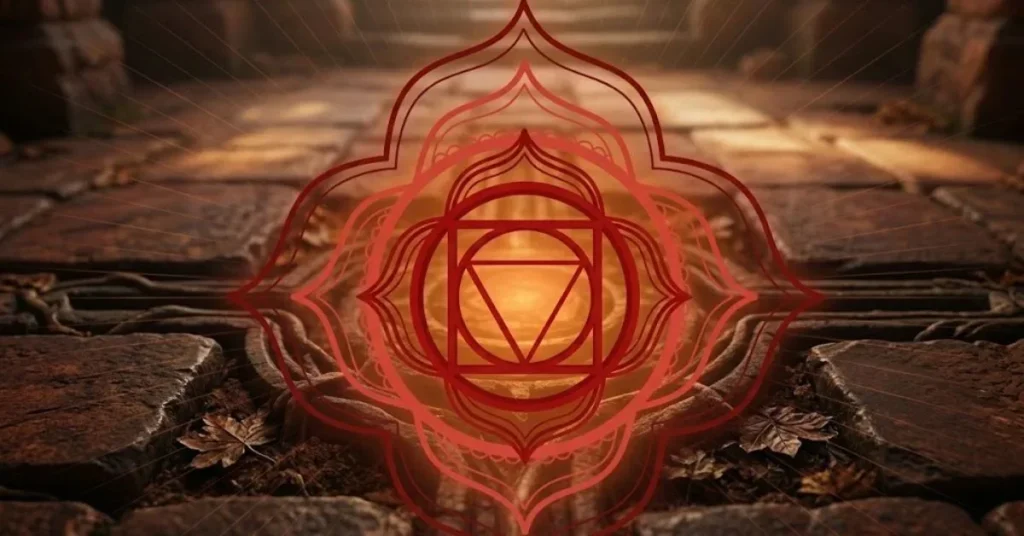
Energetically, it governs your survival instincts and your relationship with your body, shelter, food, and basic physical safety. When this chakra functions well, you feel secure in your body and your circumstances. When it’s blocked or overactive, anxiety, stress, and a constant feeling of being unmoored tend to follow.
The root chakra is also your connection to the earth itself. Grounding exercises for the root chakra often involve standing barefoot on soil or grass. That direct contact isn’t just pleasant. It shifts something in the nervous system.
Understand the Color and Property of Muladhara Chakra
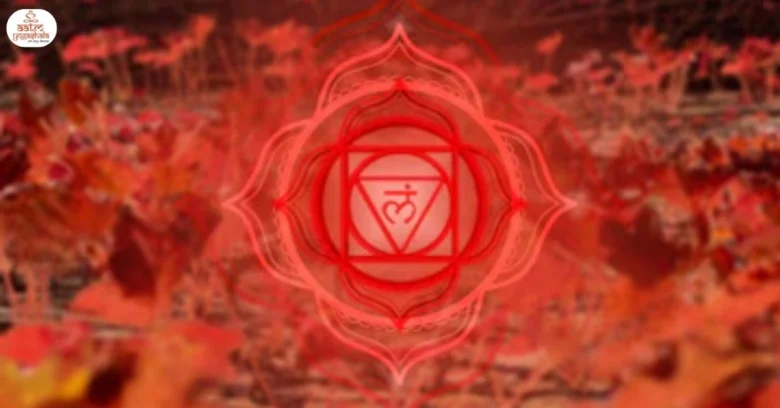
What color is the root chakra? Red. Deep, solid red. In yogic tradition, red is the color of vitality, physical energy, and the earth element. When you visualize the Muladhara Chakra during meditation or breathwork, you’re usually asked to picture a red glow at the base of your spine. Some practitioners also use red stones, like red jasper or garnet, as physical anchors during Muladhara chakra healing practices.

The symbol for root chakra is a four-petaled lotus with a square inside it. The square is the Earth symbol. A downward-pointing triangle sits within that, pointing toward the ground. It’s a simple image, and the geometry is deliberate: everything points downward, toward earth, toward stability.
Read Also:- Ayurveda Courses and Treatments in Rishikesh
Muladhara Chakra Yoga Posture Sequences
These six Muladhara Chakra yoga or asana form a complete practice. Hold each pose for at least five breaths longer if you can. The root chakra responds to slowness.
Step 1: Mountain pose (Tadasana)
Stand with your feet hip-width apart. Press all four corners of both feet into the ground. Feel the floor. This is where base chakra yoga begins, not in a complex posture but in standing still and feeling solid. Tadasana trains your awareness of physical contact with the earth. Hold for 10 breaths. Eyes open or closed. Notice whether your weight shifts to your toes or your heels, or whether it stays centered.
Step 2: Warrior I (Virabhadrasana I)
From Tadasana, step one foot back about four feet. Bend your front knee to 90 degrees. Keep your back foot pressed firmly into the ground, heel down. Raise your arms overhead. This is one of the primary Muladhara Chakra yoga postures because it asks you to root through your legs while lifting your arms. The lower body grounds. The upper body reaches. That tension is precisely what yoga for the root chakra is building: the ability to be stable and mobile at once. Hold five to eight breaths per side.
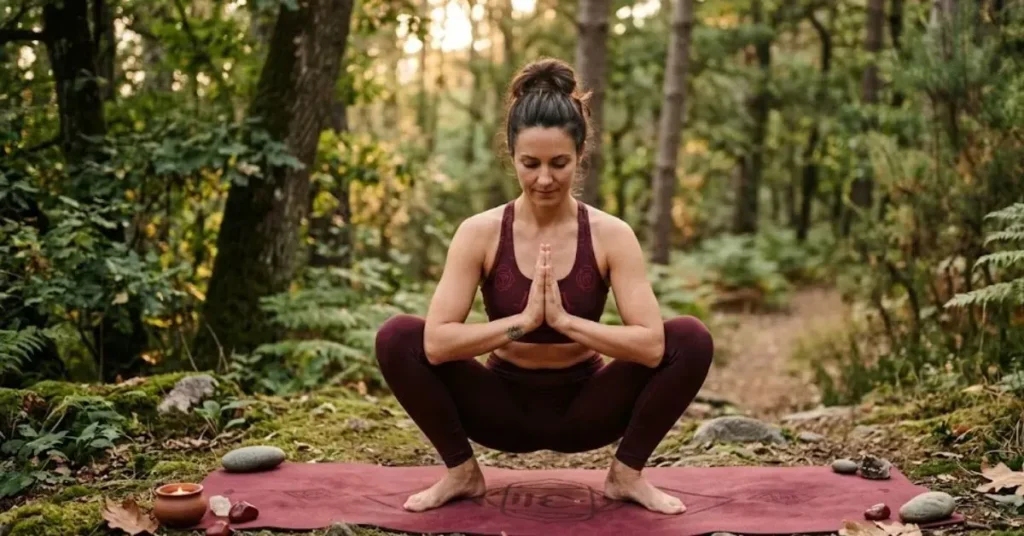
Step 3: Garland pose (Malasana)
Squat low with your feet wider than your hips, toes pointed outward. Place your palms together at your chest and utilize your elbows to gently press your inner thighs outward. Your hips drop toward the ground.
Malasana is one of the most direct Muladhara Chakra asanas. It activates the pelvic floor, the hips, and the base of the spine in one go. If you sit at a desk all day, this posture will feel uncomfortable at first. Sit with that discomfort. It’s information about where your body holds tension. Hold for eight to ten breaths.
Step 4: Bridge pose (Setu Bandhasana)
Lie on your back with your knees bent and feet flat on the floor, hip-width apart. Press your feet down and lift your hips. Clasp your hands beneath your back if comfortable. Bridge activates the base of the spine and the glutes while keeping the feet grounded.
It’s softer than the standing poses but still works directly on the Muladhara Chakra. For anyone who finds standing poses too intense (joint pain, injury, fatigue), the bridge is a gentler entry point into yoga for the root chakra. Hold for five breaths. Lower slowly. Repeat twice.
Step 5: Seated forward fold (Paschimottanasana)
Sit with both legs extended. Hinge forward from the hips, not the lower back, and reach toward your feet. Let your spine lengthen rather than curl. Forward folds calm the nervous system. In the context of Muladhara Chakra yoga postures, Paschimottanasana works by settling the energy downward. It’s an inward posture. It works differently from standing poses but serves the same function: anchoring. Hold for eight to twelve breaths.
Step 6: Savasana with Earth Visualization
Lie flat on your back. Let your feet fall open. Place your hands on your belly or at your sides. Close your eyes. For the last three to five minutes, visualize a deep red light at the base of your spine. Breathe into that area. Some teachers recommend silently repeating the seed mantra LAM. Others prefer the image alone. Do what feels less forced.
This section is where grounding exercises for root chakra and meditation overlap. Savasana looks like doing nothing. It’s the part of the practice where the body actually absorbs what happened before.
Conclusion
Not everything that feels off is a chakra problem. A bad week at work is a bad week at work. But if you’ve felt persistently unsafe, financially anxious, or physically unwell in your lower body for months, Mooladhara chakra healing deserves real attention.
The practices are the same: base chakra yoga, grounding exercises for the root chakra, visualization, and time outdoors. What changes is the consistency and the patience you bring. Healing doesn’t respond to urgency. The root chakra, in particular, requires you to slow down. That’s almost always the lesson it’s there to teach.
How to open root chakra is ultimately a question about how to stop resisting physical reality. The Muladhara Chakra grounds you in your body, in the present moment, on this specific patch of earth. Yoga postures are just a way to practice them repeatedly until they become natural.
Helpful FAQs
Q. What is the Muladhara Chakra, and where is it located?
A. The Muladhara Chakra is the first of seven chakras in the yogic system. It sits at the base of the spine, at the perineum. It governs physical safety, survival instincts, and the connection between the body and the earth element.
Q. What color is the root chakra?
A. The root chakra is red. In visualization and meditation practices, practitioners focus on a red or deep crimson light at the base of the spine to activate and balance the Muladhara Chakra.
Q. What is the symbol for the root chakra?
A. The symbol for the root chakra is a four-petaled red lotus enclosing a yellow square (the earth element) with a downward-pointing triangle at its center. The triangle and square both point toward the earth, which reflects the chakra’s function.
Q. Which yoga postures work on the root chakra?
A. The most effective Muladhara Chakra asanas are the Mountain pose, Warrior I, Garland pose, Bridge pose, and Seated forward fold. These postures activate the lower body and the base of the spine directly.
Q. How long does Mooladhara Chakra healing take?
A. There’s no fixed timeline. Regular yoga practice for the base chakra, combined with daily grounding exercises for the root chakra, produces noticeable shifts in most people within four to eight weeks. The depth of the work depends on how long the imbalance has been present.
Also Go Through:-