Kundalini Yoga Teacher Training & Chakra Awakening at a Glance
Kundalini yoga teacher training in Rishikesh is an energetic science that bridges classical Tantra, pranic kriyas and Patanjali’s Raja Yoga to awaken dormant spiritual potential (Kundalini Shakti). Anchored in source texts such as the Sat-Chakra-Nirupana and Shiva Samhita, this 200-hour Yoga Alliance accredited immersion goes beyond New Age concepts into rigorous pranic method. Through breath retention (Kumbhaka), energetic locks (Bandhas) and purification of the 72,000 nadis, practitioners safely direct life force through the spinal chakras to the crown (Sahasrara).
- Authentic Scriptural Foundation: Grounded in classical Kundalini Tantra and the Hatha Yoga Pradipika rather than modern reinterpretations.
- Seven Chakra & Nadi Mechanics: Detailed mapping of the seven chakras and the Ida, Pingala and Sushumna nadis.
- Intensive Pranic Kriyas: Daily Kapalabhati, Bhastrika, Agnisar and internal and external breath retention (Antar/Bahir Kumbhaka).
- Tri-Bandha Integration: Mula, Uddiyana and Jalandhara Bandha to channel rising prana safely.
- International Accreditation: Graduate as an RYT 200, qualified to teach Kundalini, Hatha and meditation worldwide.
1. The Reality of Kundalini Awakening vs New Age Misconceptions
Popular media often sensationalizes Kundalini as erratic movement or sudden psychological crisis. In classical Tantra, Kundalini is a methodical, progressive awakening: the latent evolutionary potential of the nervous system, coiled three and a half times at the base of the spine in Muladhara.
At Aatm Yogashala, our kundalini yoga teacher training in Rishikesh strips away sensationalism and delivers a disciplined, safe education:
- Systematic Purification: Classical texts warn that awakening without first purifying the physical sheath (Annamaya Kosha) can overload the system, so we prepare the body with Shatkarma and asana.
- Balancing Ida and Pingala: Prana cannot rise through Sushumna while the lunar and solar currents are unbalanced, so we emphasize precise alternate-nostril breathing.
- Grounded Physical Stature: Classical Hatha alignment keeps students emotionally grounded during intensive kriyas.
- Cooling Sattvic Nutrition: A diet free of garlic, onion, caffeine and excess chili keeps Pitta calm during retention practice.
- Direct Guidance from Lineage Masters: Study with Yogi Upendra Silswal and Shankar Dey for personal oversight.
- Classical Tantric Foundations: Our curriculum explores the principles of Shakti Tantra and how Shiva and Shakti unite through practice.

2. The Seven Chakras: Energetic Architecture & Anatomical Mapping
The chakra system described in the 16th-century Sat-Chakra-Nirupana parallels the major nerve plexuses and endocrine glands along the spine. Understanding this map is essential for any qualified teacher:
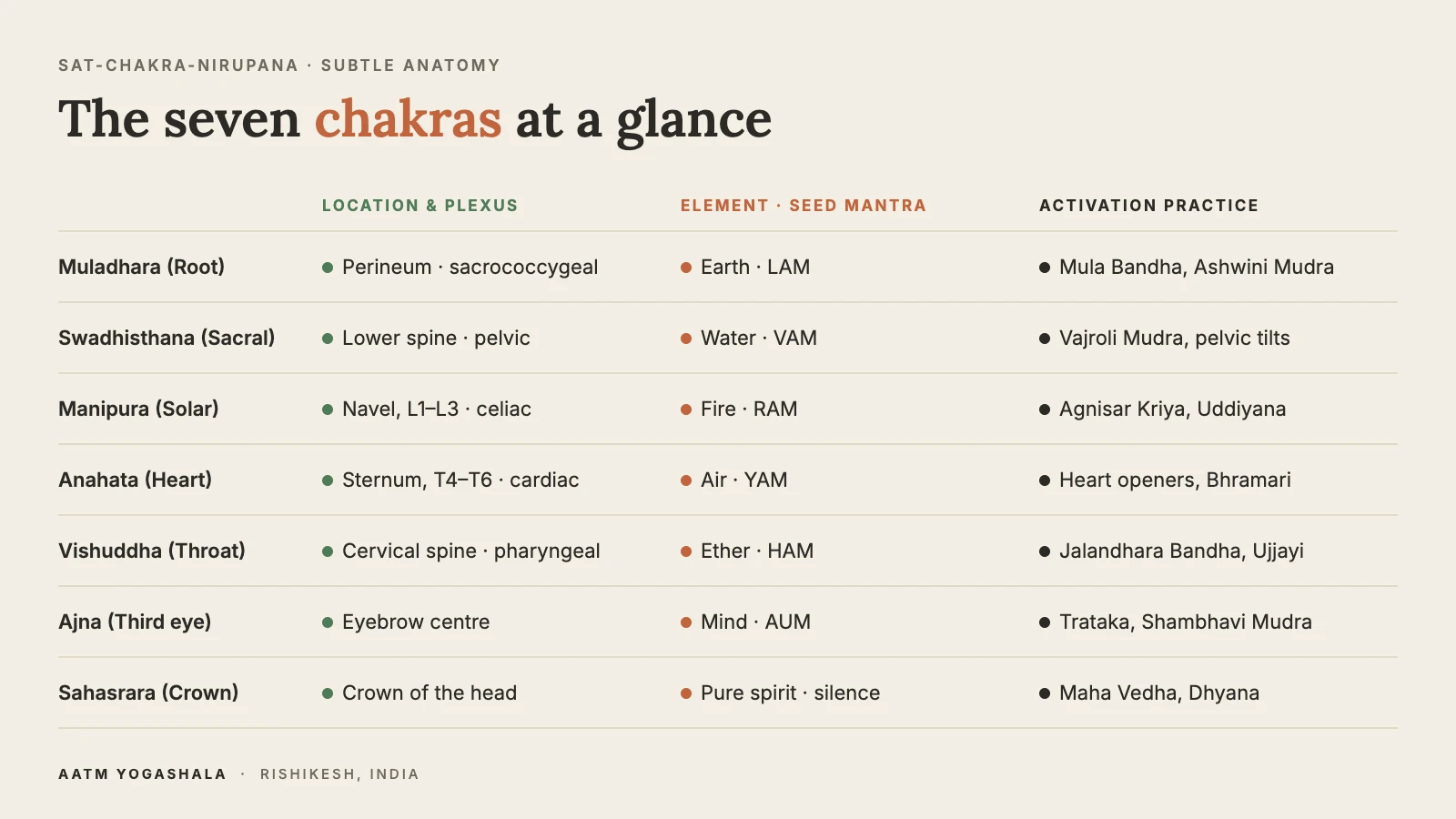
| Chakra | Location & Plexus | Element & Seed Mantra | Gland & Physiology | Activation Kriya |
|---|---|---|---|---|
| 1. Muladhara (Root) | Perineum / coccyx; sacrococcygeal plexus | Earth / LAM | Adrenals; skeletal roots | Mula Bandha, Ashwini Mudra |
| 2. Swadhisthana (Sacral) | Lower spine; pelvic plexus | Water / VAM | Gonads (reproductive vitality) | Vajroli Mudra, pelvic tilt |
| 3. Manipura (Solar) | Navel, L1–L3; celiac plexus | Fire / RAM | Pancreas; digestive fire | Agnisar Kriya, Uddiyana Bandha |
| 4. Anahata (Heart) | Sternum, T4–T6; cardiac plexus | Air / YAM | Thymus (immunity) | Heart-opening asana, Bhramari |
| 5. Vishuddha (Throat) | Cervical spine; pharyngeal plexus | Ether / HAM | Thyroid & parathyroid | Jalandhara Bandha, Ujjayi |
| 6. Ajna (Third Eye) | Eyebrow centre | Mind / AUM | Pineal & pituitary | Trataka, Shambhavi |
| 7. Sahasrara (Crown) | Crown of the head | Pure spirit / silence | Cerebral cortex | Maha Vedha, Samadhi Dhyana |
- The Root Foundation (Muladhara & Swadhisthana): Governs grounding and emotional regulation, explored in our guide to Muladhara chakra yoga.
- Sacred Chakra Symbology: Study the mandalas and seed syllables in 7 chakra symbols, meanings and colors.
- The Solar Engine (Manipura): The internal furnace; Agnisar and Uddiyana burn through metabolic stagnation (Ama).
- The Bridge of Compassion (Anahata & Vishuddha): Turns personal ego into empathy and clear expression.
- The Upper Centres (Ajna & Sahasrara): Awaken intuition (Prajna) and dissolve inner conflict into stillness.
3. Curriculum Breakdown of the 200-Hour Kundalini TTC
| Module | Hours | Core Competencies |
|---|---|---|
| Kundalini Kriyas & Breathwork | 75 | Kumbhaka ratios, Bhastrika, Kapalabhati, Bandhas and Mudras |
| Teaching Methodology & Safety | 50 | Cueing, managing emotional release, sequencing energy flows, adjustments |
| Subtle Anatomy & Biomechanics | 30 | Nerve plexuses, endocrine glands and spine kinematics |
| Tantric Philosophy & Scriptures | 30 | Sat-Chakra-Nirupana, Shiva Samhita, Hatha Yoga Pradipika, Yoga Sutras |
| Integrative Practicum & Mantra | 15 | Peer-teaching clinics, Nada Yoga and Sanskrit chanting |
- Advanced Pranic Kriyas: Internal and external retentions up to the classical 1:4:2:1 ratio, with hand and eye mudras. Sequences build on our five Kundalini yoga poses.
- Neurobiology of Subtle Energy: How chakra stimulation relates to the vagal complex and nervous-system regulation.
- Philosophical Lineage: Kashmir Shaivism, the union of Shiva and Shakti, and Yama and Niyama.
- Student Safety and Energy Containment: How to hold emotional breakthroughs and hyperventilation responses calmly and safely.
4. Daily Schedule of a Kundalini Trainee
| Time | Practice | Objective |
|---|---|---|
| 05:30 – 06:00 AM | Wake-up, Ushapan & herbal tea | Hydration and quiet preparation |
| 06:00 – 06:45 AM | Shatkarma kriyas | Jala Neti, Agnisar, Kapalabhati |
| 07:00 – 08:30 AM | Kundalini kriyas & asana | Chakra-specific asana and breath |
| 08:30 – 09:30 AM | Pranayama & bandhas | Retentions; Mula, Uddiyana, Jalandhara |
| 09:30 – 10:30 AM | Sattvic breakfast | Porridge, fruit, herbal infusions |
| 11:00 AM – 12:15 PM | Chakra anatomy | Nerve plexuses and endocrine glands |
| 12:30 – 01:30 PM | Tantra philosophy | Sat-Chakra-Nirupana, Shiva Samhita |
| 01:30 – 02:30 PM | Sattvic lunch | Dal, rice, vegetables, rotis |
| 02:30 – 04:00 PM | Rest & self-study | Reading, journaling, recovery |
| 04:00 – 05:30 PM | Teaching methodology | Peer adjustments, sequencing, voice |
| 05:45 – 07:00 PM | Kundalini meditation & sound bath | Nada Yoga and chakra visualization |
| 07:15 – 08:15 PM | Light dinner | Soups, mung dal, herbal teas |
| 08:30 – 09:30 PM | Satsang / kirtan | Japa chanting and reflection |
| 09:30 PM | Noble silence (Mauna) | Digital disconnection and rest |
5. Kundalini Safety: Bandhas and Energetic Containment
Awakening prana without containment can bring headaches, palpitations, insomnia or emotional instability. In classical yoga, the Bandhas act as circuit breakers, directing rising prana into Sushumna instead of letting it scatter:
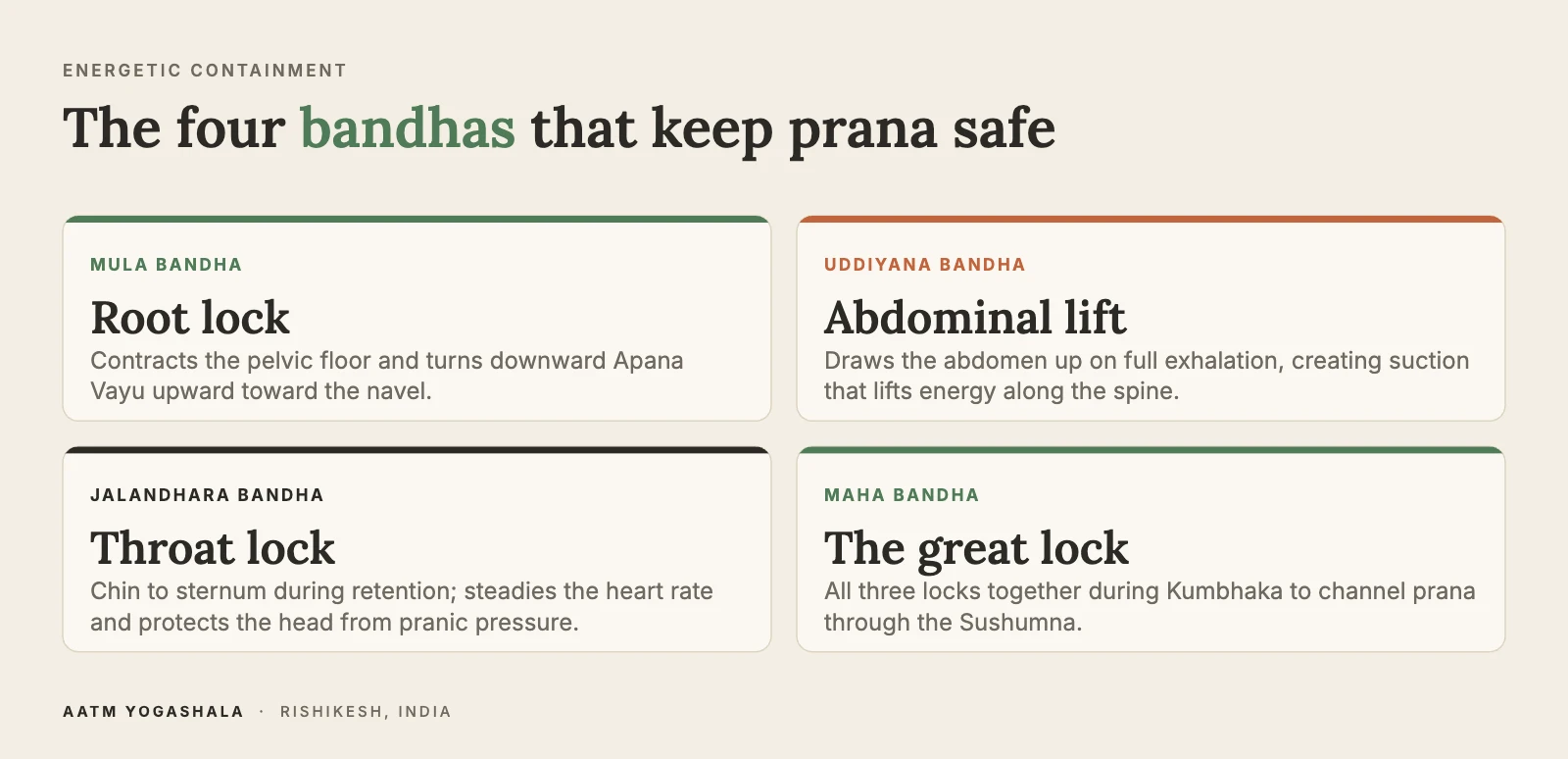
- Mula Bandha (Root Lock): Contracting the pelvic floor blocks downward-flowing Apana Vayu and turns it up toward the navel to meet Prana Vayu.
- Uddiyana Bandha (Abdominal Lift): On an empty stomach after full exhalation, the abdomen draws up, creating negative pressure that lifts subtle energy.
- Jalandhara Bandha (Throat Lock): The chin rests on the sternum, lowering the heart rate during retention and keeping pranic pressure out of the head.
- Maha Bandha (Great Lock): All three locks during Kumbhaka, channelling prana through the knot of Brahma (Brahma Granthi).
- Grounding Counter-Practices: Every intensive session ends with 15 minutes of Shavasana, barefoot walking and warm sattvic food.
6. What Is Included in Your Residential Package
Batches run from the 3rd to the 24th of every month. All-inclusive fees are $899 USD (Triple Sharing), $1,199 USD (Double Sharing) and $1,299 USD (Private Room):
| Inclusion | Aatm Yogashala 200-Hour Kundalini TTC | Typical Western Training |
|---|---|---|
| Accreditation | Yoga Alliance USA RYS 200 | Often unaccredited or independent |
| Tuition & Housing | $899 – $1,299 USD all-inclusive | $2,800 – $4,500 USD tuition only |
| Accommodation | Private or shared room with mountain balcony | Hotel paid separately |
| Meals | 3 sattvic Ayurvedic meals daily | Not included |
| Kriya & Shatkarma Kit | Copper Neti pot, sutra and manual included | Extra fee |
| Sound Healing | Tibetan singing bowl sound baths included | $120+ per session |
| Excursions | Vashistha cave, Kunjapuri sunrise, Ganga Aarti | Extra tour charges |
- All-Inclusive Pricing: Tuition, room, 3 daily meals, textbooks and excursion transport with no hidden costs.
- Sacred Ashram Location: Yoga Village – Jonk near Ram Jhula in Swargashram, away from highway traffic.
- Progression to RYT 500: Continue with our 300-hour yoga teacher training in Rishikesh.
- Student Preparation: Read our Yogic Food and Accommodation guide and Student FAQs.
7. Frequently Asked Questions
Yes. Taught within classical Vedic and Tantric tradition, Kundalini practices are introduced step by step. Teachers assess each student’s capacity, foundational Hatha postures come first, and advanced breath retention is introduced only once students show calm respiratory control.
Classical Hatha yoga focuses on asana alignment, joint stability and steady holds. Kundalini yoga uses asana as a conduit to activate subtle pranic currents, the chakras and the Sushumna Nadi through repetitive kriyas, bandhas and breath retention. Both come from the same Tantric roots.
Yes. Aatm Yogashala is a Registered Yoga School (RYS 200). Graduates can register as an RYT 200 with Yoga Alliance USA and teach Kundalini, Hatha and meditation worldwide.
Students eat a sattvic vegetarian diet prepared to Ayurvedic principles, without onion, garlic, coffee, alcohol or refined sugar. Vegan and gluten-free needs are accommodated with notice.
Check the dates and submit the online reservation form with a small deposit. The admissions team then sends a confirmation letter and preparation guidelines.
8. Next Step: Apply for the Certified Kundalini Training
- Enrollment: Apply for the 200-Hour Kundalini Yoga TTC
- Shorter Option: Try the 100-hour Kundalini yoga teacher training in Rishikesh.
- Admissions Help: Use our Contact Page or WhatsApp +91 84459 93766 for travel, transfers and batch availability.